


Built upon the GloryIGI industrial large model and integrating agentic AI with diverse capabilities, LOFA implements smart manufacturing upgrade scenarios across industrial applications to serve as the fab’s smart control hub and unified system entry point. It achieves process automation and AI-driven recognition/parsing, allowing virtual assistants to replace or assist across multiple roles, transform production workflows, reduce costs, improve efficiency, and elevate fab decision-making and workforce productivity.

Relying on industrial large models and knowledge graphs, it builds an enterprise-exclusive smart assistant system. GloryIGI captures and consolidates industry-specific and proprietary enterprise knowledge to support intelligent Q&A, analysis, and decision-making assistance across high-value scenarios such as R&D, production, equipment, and management, driving continuous intelligent upgrades in industrial scenarios.

Based on multimodal information collection including images, video, and voice, combined with AI agents and reasoning large models, PMS automatically understands inspection and fault scenarios, matches maintenance and repair solutions from the equipment knowledge base, and generates actionable operational guidelines to achieve an intelligent and process-driven closed loop for equipment inspection, diagnosis, and maintenance.

Combining AI and large model capabilities, YMS automatically analyzes process, inspection, and quality data, identifies correlation between yield and defects, enables anomaly early warning, root-cause analysis, knowledge accumulation, and decision support, building an intelligent closed loop for continuous quality improvement.

BDP uniformly integrates data from MES, equipment, inspection, and business systems, relying on big data and intelligent analytics technologies to perform data governance, feature modeling, and metric analysis, supporting the rapid construction and stable operation of diverse AI applications such as quality, yield, equipment, and operations.
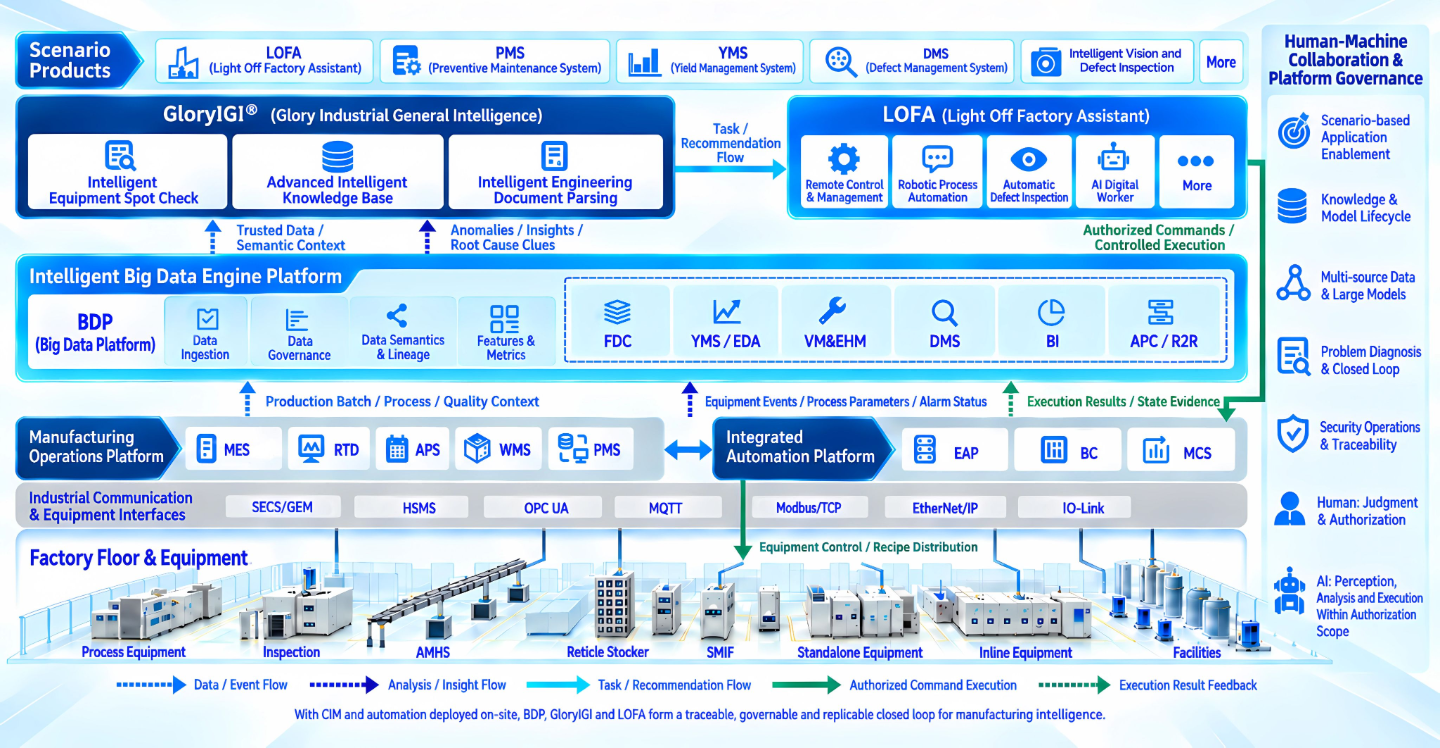
Tap the diagram to open the full-size architecture. Use the zoom control to inspect individual modules.
1. Connect the factory. Equipment and industrial interfaces connect to manufacturing operations (MES, RTD, APS, WMS and PMS) and integrated automation (EAP, BC and MCS).
2. Build trusted data. BDP brings together data ingestion, governance, semantic lineage, features and metrics. FDC, YMS/EDA, VM & EHM, DMS, BI and APC/R2R use this foundation for monitoring, analysis and control.
3. Turn knowledge into recommendations. GloryIGI combines equipment inspection, an intelligent knowledge base and engineering document parsing to support industrial understanding and task recommendations.
4. Execute and improve. LOFA supports remote control management, robotic process automation, automatic defect inspection and AI digital workers. Execution results feed back into the process.
5. Keep people in control. Human judgment and authorization, security, permissions and traceability govern AI recommendations and controlled execution.

• Delivering scenario-specific tools, such as LOFA and PMS tailored for industrial scenarios including lights-off factories, equipment maintenance, and yield management.
• Combining with the Big Data Platform (BDP) to perform deep analysis of production data, elevating equipment O&M efficiency and product yield.

• Knowledge Management: Accumulating and reusing smart manufacturing business knowledge through document parsing, knowledge graph construction, and knowledge base O&M.
• Model Management: Supporting model training, deployment, monitoring, and fine-tuning to ensure continuous iteration and stable operation of AI models.

• Integrating multi-source data including historical, master, planning, and business data, combined with multimodal and reasoning large models to achieve intelligent understanding and reasoning in complex scenarios.• Built on open-source large model foundations, supporting flexible model training and expansion.

• Achieving precise issue localization through multimodal technologies, and quickly matching solutions by combining intent recognition with solution retrieval.• Covering a complete closed loop from issue discovery, diagnosis, and solution pushing to feedback optimization, supporting intelligent diagnosis and decision assistance for customer business issues.

• Providing platform security management functions such as permission, account, key, and log management to ensure stable platform operation and data security.• Enabling platform operations to be traceable and manageable through features such as issue tracking.